

Mon-Fri from 9:00 to 18:00
Sat-Sun Closed
Contact us
Catalog
Main menu
Catalog

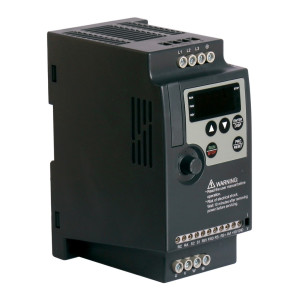
Scalar-Controlled Frequency Converters

Sort By:
Default
113 074,00 UAH -50%
56 536,98 UAH
Operating mode Scalar control
Output frequency 0.1 to 400 Hz
Output voltage 3ph 380V
Supply voltage 3ph 380V
Power 45 kW
More
195 655,00 UAH -50%
97 827,00 UAH
Operating mode Scalar control
Output frequency 0.1 to 400 Hz
Output voltage 3ph 380V
Supply voltage 3ph 380V
Power 110 kW
More

Scalar-Controlled Frequency Converters

What is a Scalar Frequency Converter?

A Scalar Frequency Converter (SFC) operates by changing the amplitude and frequency of the voltage supplied to an electric motor. They control the ratio of output voltage to frequency (V/f) following a linear or quadratic law to maintain constant motor magnetic flux.

This means that when you adjust the frequency at the output of the converter, the electronics simultaneously adjust the output voltage. An example of changing the output voltage is shown in the figure above, line 1.

In practical terms, using a scalar frequency converter means that with a reduction in the motor's rotational frequency, its torque significantly decreases. Changes in motor torque over the frequency range from zero to 50 Hz are shown as curve number 2. In other words, at low motor rotation frequencies controlled by a scalar frequency converter, the motor shaft torque can become so small that it can be easily stopped by external loads.

What is Motor Boost?

To increase the torque of motors controlled by a scalar frequency converter at low frequencies, a so-called Boost is used - it is the voltage applied to the motor at low frequencies. The voltage value can reach up to 30% of the nominal value. This significantly increases the motor torque, shown by lines 3 and 4, but also requires the installation of additional equipment, namely forced cooling fans, which provide sufficient airflow to cool the motor stator when operating at low frequencies with high torque.

Why does the Output Voltage Stop Increasing above 50 Hz?

You may also notice that after increasing the output frequency beyond 50 Hz, the output voltage reaches its maximum, depending on the type of scalar frequency converter, it can be 220V or 380V, and further, this voltage does not increase. As the output frequency continues to rise, the motor torque begins to decrease significantly (line 5). There are several reasons:

  1. Inductive Effect: Many stator windings (the stationary part) of motors are inductive. As the frequency increases, electromagnetic inductive effects become more pronounced, leading to decreased performance and reduced torque.
  2. Iron Losses: Increasing frequency also causes additional losses in the stator's magnetic material as magnetic fields change more quickly. This leads to additional heating of the stator and reduced torque.
  3. Eddy Currents: As the supply frequency increases, higher eddy currents occur in magnetic materials, which can reduce efficiency and cause extra losses.
  4. Skin Effect: At high supply frequencies, current concentrates in the surface layers of the conductor due to the skin effect. This can lead to increased resistance and losses in the conductor, which also impact torque.
  5. Material Limitations: The materials used in motor construction have certain electrical and magnetic properties that may limit performance at high frequencies.

Important Aspects to Know and Understand about Scalar Frequency Converters.

  • A scalar frequency converter does not track the fact that the motor is rotating. It only adjusts the output voltage in proportion to the set frequency. This means when controlling a motor with a scalar frequency converter, especially at low frequencies, the motor's output shaft can be stopped while the frequency converter will not error, provided that the maximum current for the converter is not exceeded.
  • Scalar frequency converters are best used to control motors with fixed or smoothly changing torque that depends on the motor's rotational speed.
  • These converters are well-proven as spindle drives for wood milling machines. The feature of these spindles is low torque and high rotation frequency.

Where are Scalar Frequency Converters Used?

SFCs are used in systems with constant or slightly varying loads:

  • conveyors,
  • pumps,
  • fans,
  • conveyors,
  • low-power machines.

Advantages of Scalar Frequency Converters

The use of scalar frequency converters for regulating the speed of electric motors offers several advantages, making them an efficient solution in many fields:

  • Low cost. Scalar converters are significantly cheaper than vector ones for the same motor power.
  • Simplicity and reliability of design. The absence of feedback sensors makes scalar drives less prone to breakdowns.
  • Energy savings through optimizing the operational speed of equipment.
  • Smooth start and speed regulation of the motor, extending the lifespan of mechanisms.
  • Ability to maintain set process parameters using a PID controller.
  • Protection of the motor from overloads and emergencies.
  • Compact size and ease of control.

Disadvantages of Scalar Frequency Converters

  • low precision and dynamic regulation;
  • torque reduction at low speeds.

Thus, using scalar frequency converters for simple tasks is an efficient solution for controlling the speed of inexpensive asynchronous drives with constant loads that do not require high precision and dynamics. The application of affordable scalar converters is an optimal solution that offers a quick return on automation costs. They are widely used due to their simplicity and affordable price.

Show more