



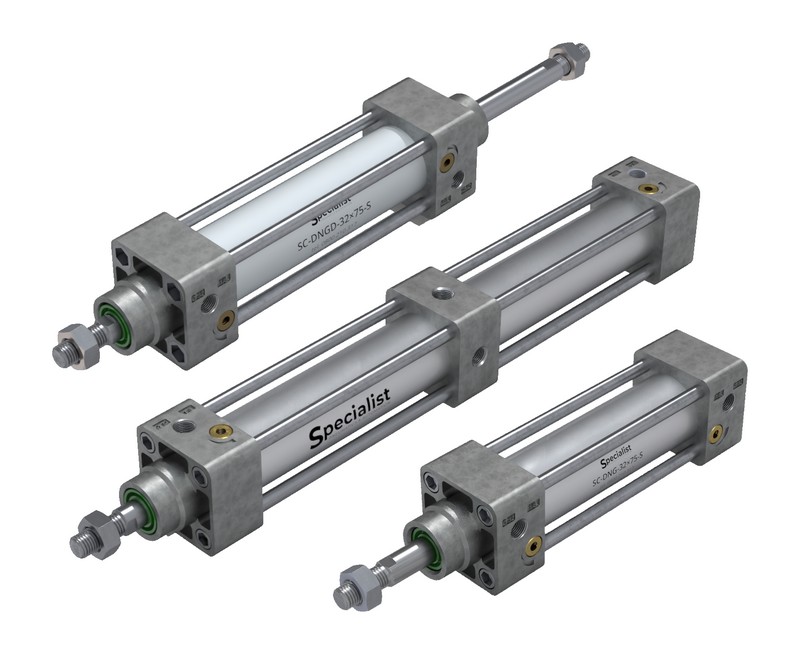
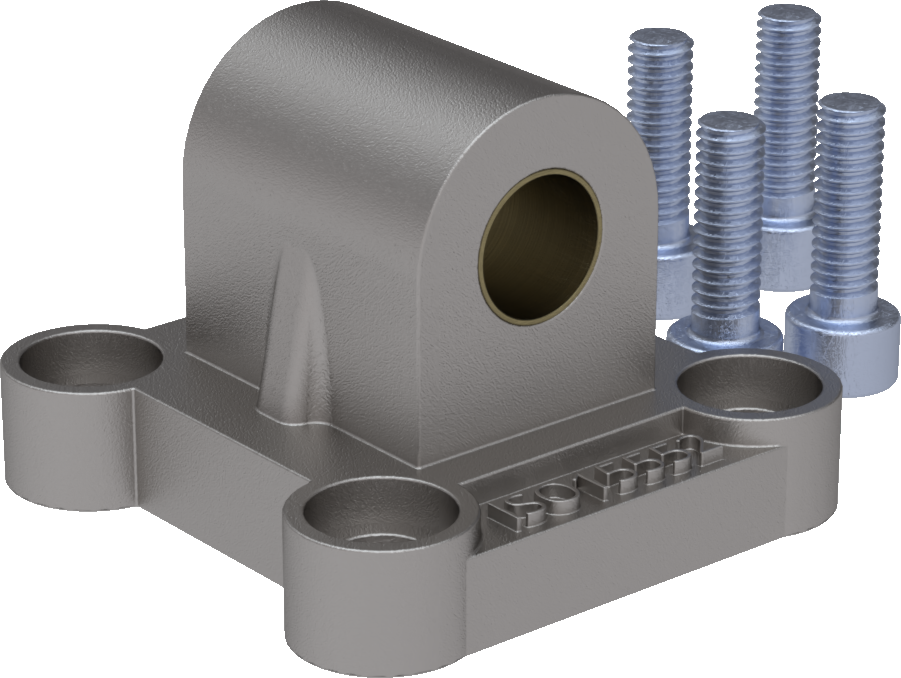
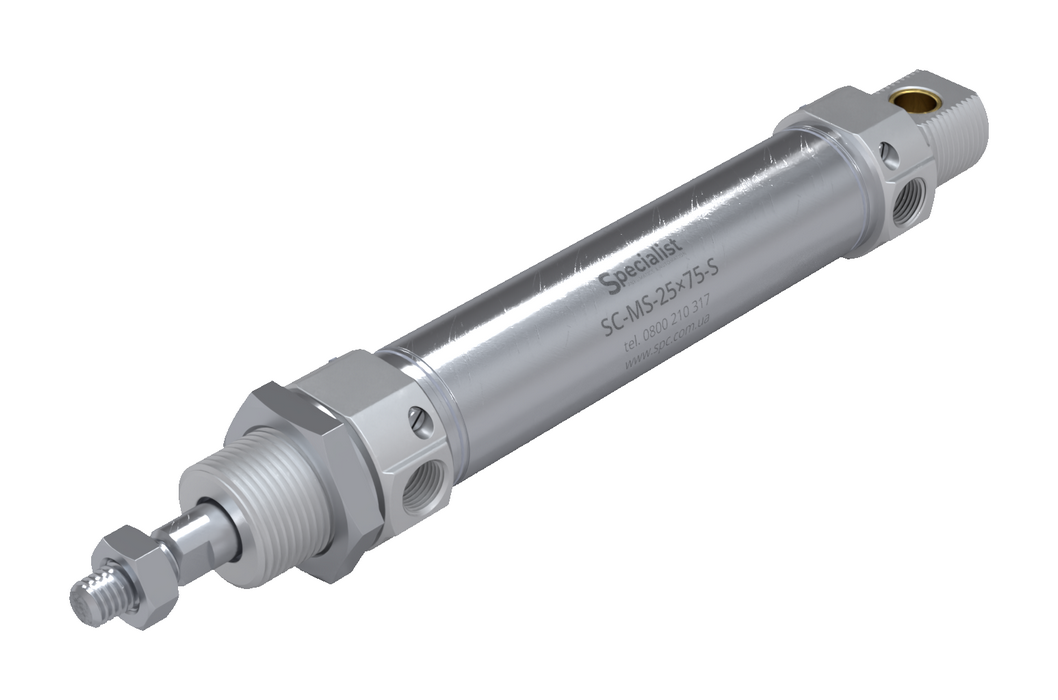

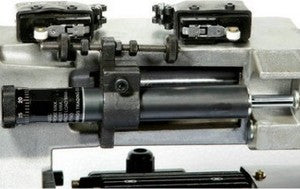
In cases where the internal cushioning of pneumatic cylinders is insufficient to absorb the impact force, a hydraulic shock absorber should be used for more effective and smooth braking at the end of the stroke. Special hydraulic shock absorbers can also be used to regulate the extension and retraction speed of the rod.
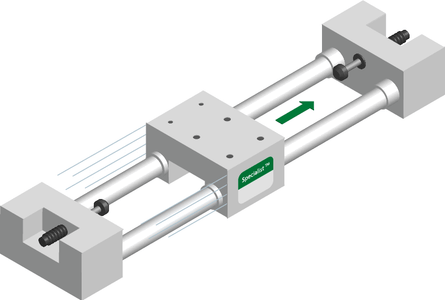
Purpose and design of hydraulic shock absorbers
External hydraulic devices for braking pneumatic cylinders are divided into several types according to their purpose. Types of hydraulic shock absorbers:
- Hydraulic shock absorbers (shock absorbers) with self-compensation of the SC-АС series are designed for non-impact stopping of the rod at the end of the stroke;
- adjustable hydraulic shock absorbers of the SC-АD series, which differ from the SC-АС series by the ability to adjust the braking speed;
- hydraulic speed stabilizers of the SC-НР series are designed to ensure smooth and constant movement speed of the pneumatic cylinder.
How a hydraulic damper is designed
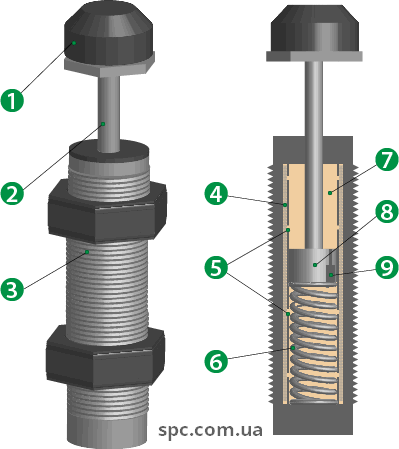
Structurally, the hydraulic damper consists of the following parts:
- Nylon tip (optional)
- Steel plunger
- Steel housing
- Accumulator
- Orifices
- Return spring
- Working fluid
- Piston
- Check valve
The entire housing of the hydraulic damper is threaded, which not only allows the braking device to be installed, but also increases the efficiency of heat dissipation.
Operating principle of the SC-AC hydraulic shock absorber
The SC-AC hydraulic shock absorber for impact-free stopping is installed so that it is aligned with the load (the misalignment should be less than 0.25°). At the moment of impact, the external force is transmitted through the tip (1) and plunger (2) to the piston (8), causing it to move. Since the internal cavities of the shock absorber are filled with working fluid, compression in the rodless area causes it to flow through the orifices (5) into the accumulator, which is a tube made of porous material, and from the accumulator into the upper chamber. As the fluid moves, mechanical energy is converted into thermal energy, transferred to the housing and radiated into the surrounding environment. Thus, kinetic energy is dissipated by means of the hydraulic damper.
At the end of each cycle, after the load is removed, the return spring (6) returns the piston to its initial position. Oil from the rod chamber flows back through the check valve (9).

Operation of the SC-AD hydraulic shock absorber
The adjustable SC-AD hydraulic damper has a throttle in its design, whose flow cross-section is changed by turning the adjustment ring (the ring is rotated using a thin metal rod). This makes it possible to limit the flow of oil moving from one cavity to another and control the braking speed. For precise adjustment, a scale from 0 to 6 is marked on the housing, where 0 corresponds to the slow braking mode, and 6 to the fastest. The adjustment ring can only be rotated when the load has been removed from the SC-AD hydraulic damper.
Speed adjustment SC-HR
The SC-HR hydraulic speed regulator operates similarly to the SC-AC and SC-AD hydraulic dampers, but its mechanism provides precise and stable control of the load speed along the entire length of the rod stroke. The hydraulic speed regulator is used for various types of automatic machines — drilling, grinding, and cutting machines.
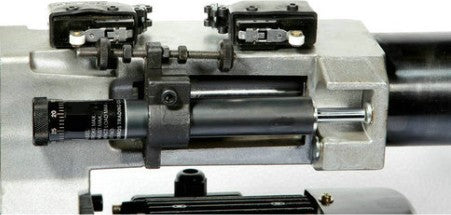
The hydraulic speed regulator can have a mechanical or pneumatic return spring.
Haven't chosen a hydraulic shock absorber or still have questions?
Our employees will help you choose hydraulic dampers and other accessories for pneumatic cylinders.
Call us toll-free in Ukraine
+38 0800 210 317Our catalog features single-acting hydraulic shock absorbers. You can also order a double-acting hydraulic damper from our manager.

