



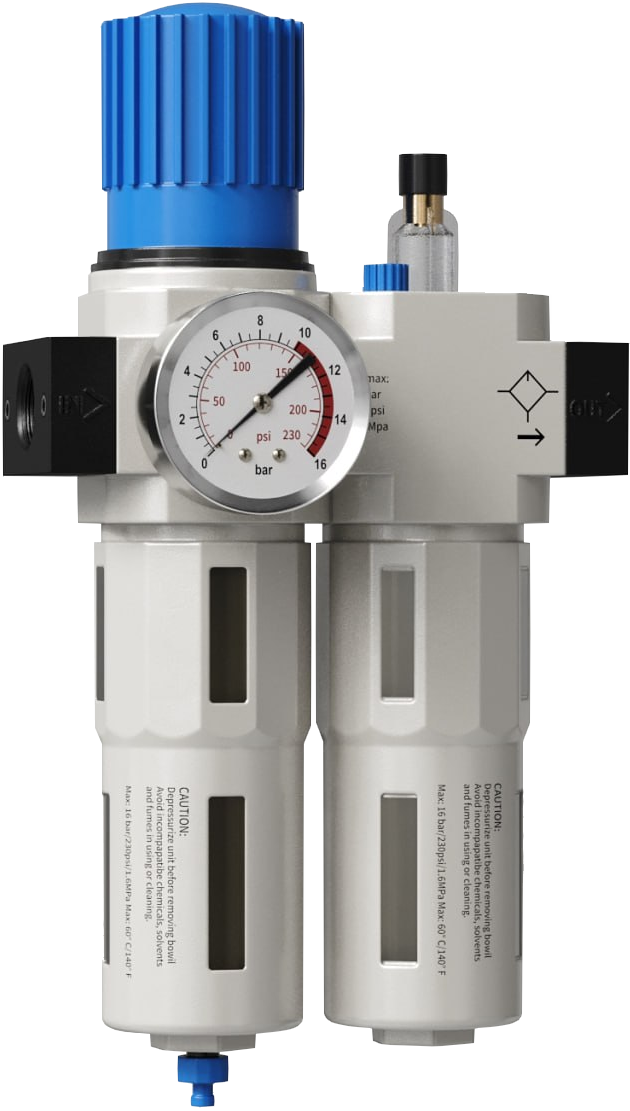
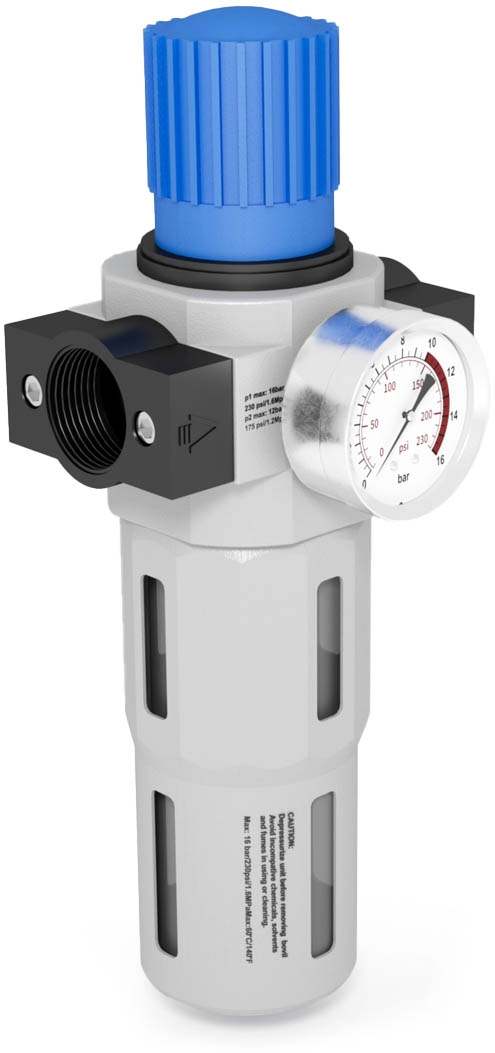
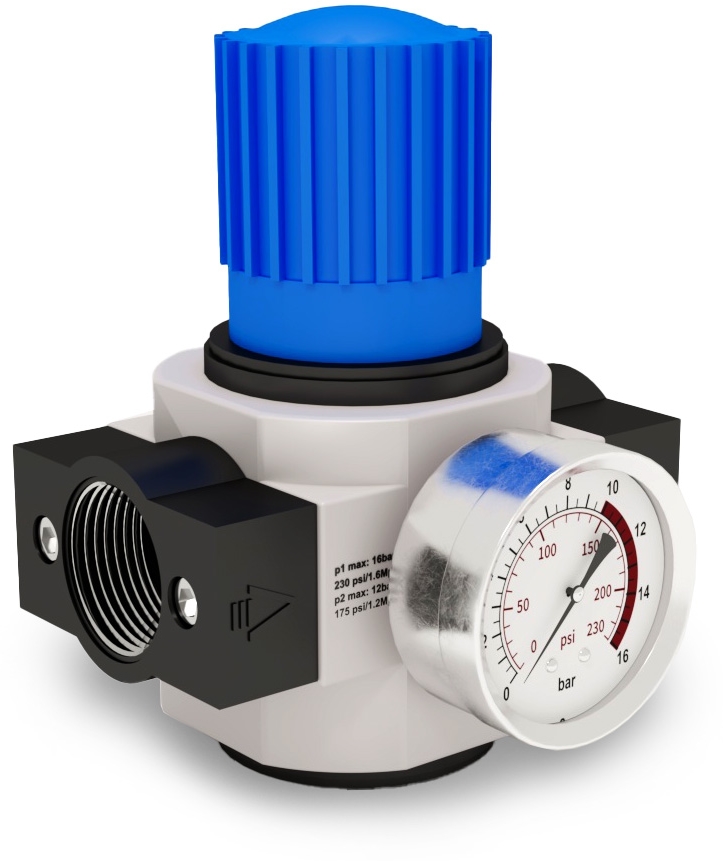
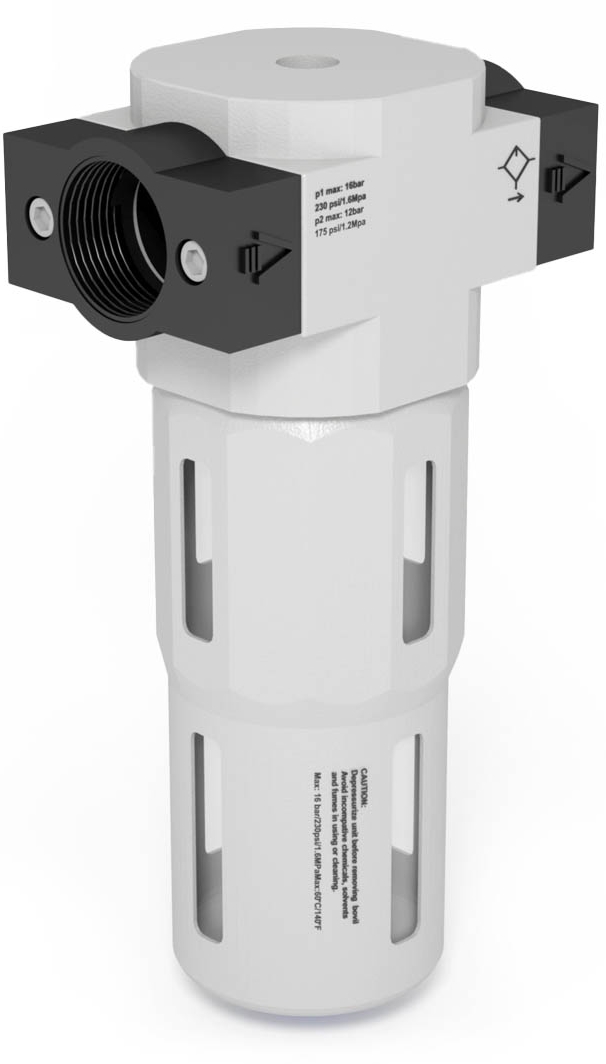

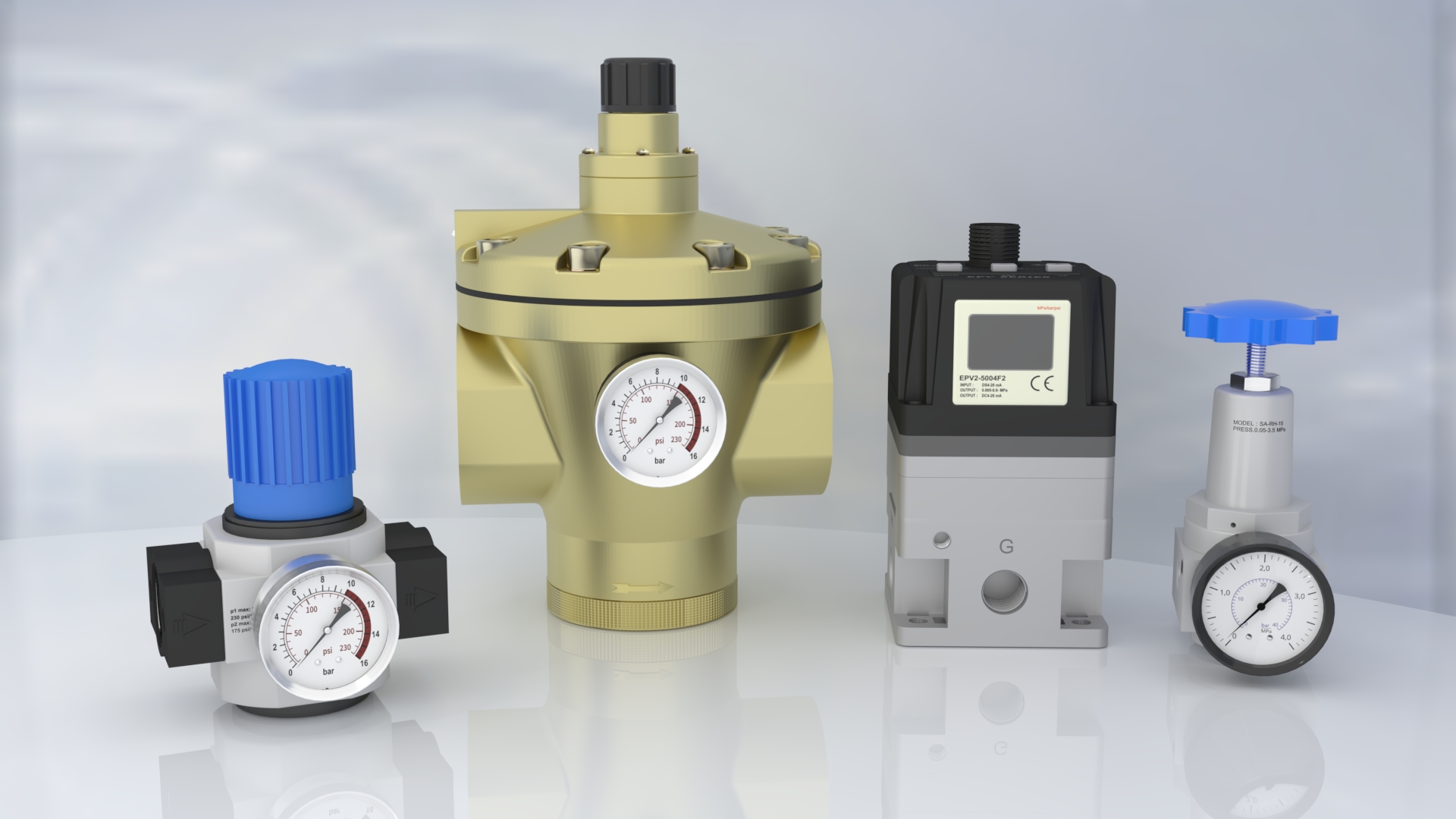
- Pressure regulators with operating pressure up to 12 bar.
- High-pressure regulators up to 35 bar.
- Precision pressure regulators for accurate pressure control.
- Electronic regulators for automated process control.
- Selecting the optimal pressure regulator for different applications.
- Installation and adjustment requirements.
The importance of compressed air pressure regulation in industrial applications.
Regulating compressed air pressure is an important aspect of industrial processes, allowing control over the speed and power of pneumatic tools and machinery.
Compressed air pressure regulation allows control of the speed and power of pneumatic tools and machinery, which makes it possible to:
- Avoid excessive energy consumption.
- Increase the efficiency of pneumatic tools and machinery.
- Reduce equipment wear and extend its service life.
- Ensure workplace safety and prevent damage to equipment and materials.
Pressure regulators with operating pressure up to 12 bar
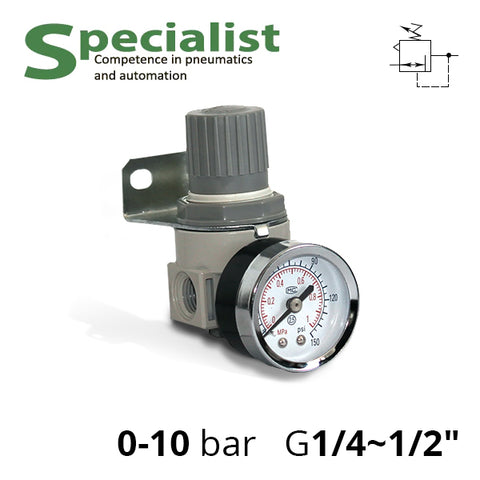
Description and operating principle
An air pressure regulator with an operating pressure up to 12 bar is typically used in low-pressure systems. The air pressure regulator is supplied complete with a pressure gauge.
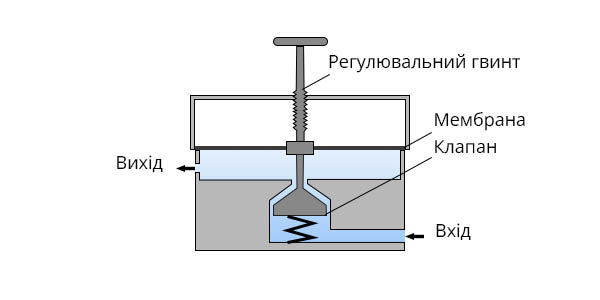
The operating principle of the pressure regulator is based on the use of a spring and a diaphragm that respond to pressure changes in the system. When the system pressure exceeds the set value, the diaphragm begins to deform, increasing the spring force and closing the valve. This limits the pressure in the system and prevents it from rising further.
Applications and air quality requirements
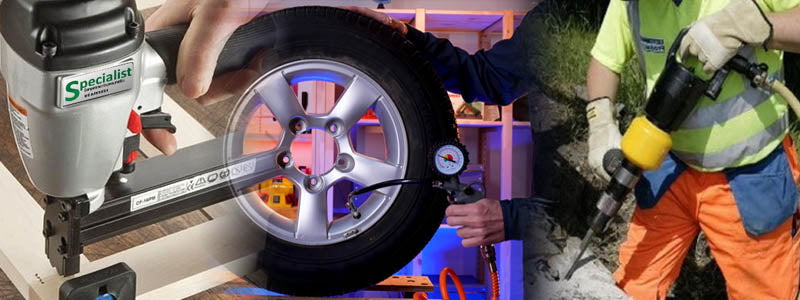
An air pressure regulator can be used after a compressor in various applications, including regulating air pressure in pneumatic systems, gas pressure in pipelines, water pressure in irrigation systems, and more. Pressure regulators with operating pressure up to 12 bar can be used in systems where the pressure level is relatively low.
High-pressure regulators up to 35 bar
Description and operating principle
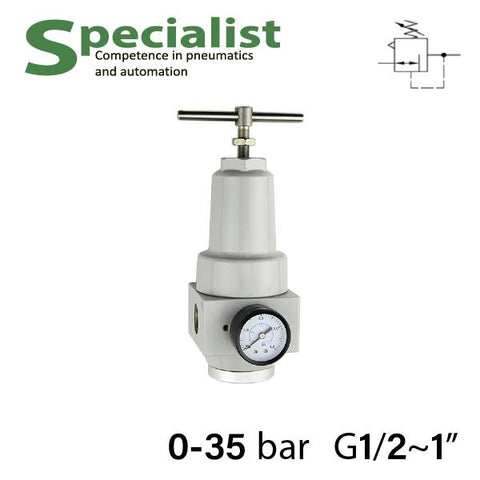
High Pressure Regulators (HPR) are devices used to regulate pressure in high-pressure systems (up to 35 bar). They provide precise pressure control by reducing it to the required level and maintaining it despite flow rate changes. Their operating principle is similar to that described above. The main difference lies in the materials, springs, and pistons designed to operate at high pressures.
Applications and air quality requirements
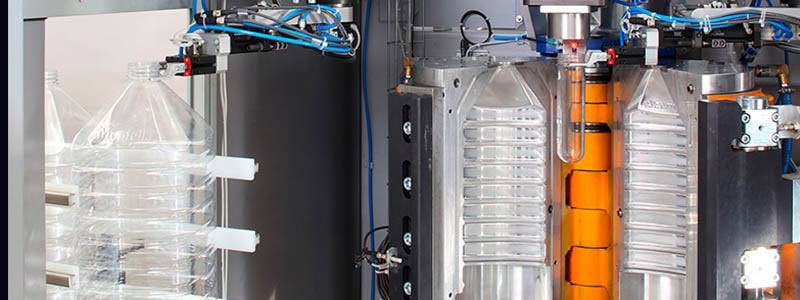
HPRs are widely used in the food industry (PET bottle blowing), medicine, scientific research (sample testing chambers), and other fields.
For proper operation of high-pressure regulators up to 35 bar, high-quality air is required. Air quality must comply with specific standards to avoid equipment damage and ensure personnel safety. The air pressure regulator is supplied with a 40-bar pressure gauge.
Precision pressure regulators for accurate pressure control
Description and operating principle
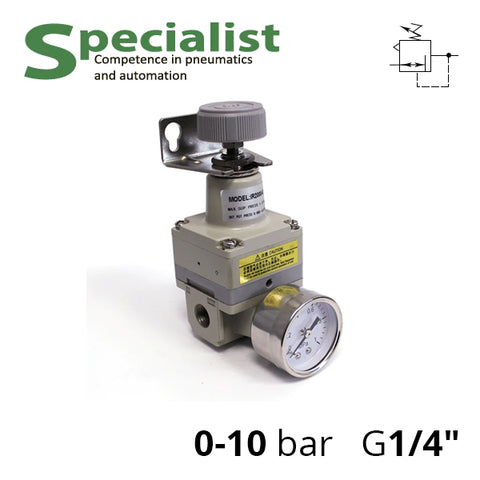
Precision regulators are devices used for highly accurate pressure control. They ensure stable outlet pressure even when the compressor inlet pressure or air consumption changes.
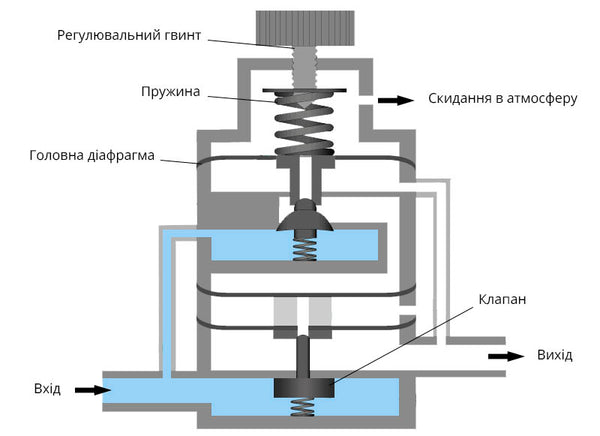
The operating principle of precision regulators is based on balancing forces between the inlet and outlet pressures. When the outlet pressure decreases, the spring compresses, opening the valve and increasing airflow. When the outlet pressure increases, the spring expands, closing the valve and reducing airflow.
Applications and air quality requirements
Precision regulators are often used in laboratories, manufacturing processes, analytical instruments, and other applications where precise pressure control is required, such as painting, adhesive application, and process control. They typically offer high accuracy and reliability, enabling stable outlet pressure over long periods.
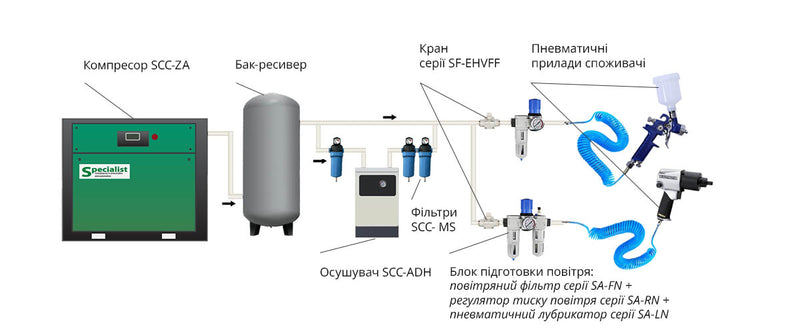
Important air quality requirements include cleanliness and dryness. Filters are used to remove dust, dirt, oil, and other contaminants. Air dryers are used to remove excess moisture from the air.

Advantages and disadvantages of using such regulators
Advantages of precision regulators:
- Accuracy: precision pressure regulators provide highly accurate pressure settings.
- Stability: precision regulators maintain stable system pressure. They can compensate for pressure variations and maintain constant pressure regardless of operating conditions.
- Reliability: they can operate in various conditions for long periods without replacement. This requires compliance with operating temperature limits, proper air preparation, absence of excessive oil, and solid particles no larger than 20 μm. If oil mist needs to be introduced into the air, the lubricator should be installed after the precision regulator.
Disadvantages of precision regulators:
- Cost: a precision pressure regulator is usually more expensive than standard regulators.
- Continuous venting of air to the atmosphere. To ensure maximum pressure control accuracy, the regulator continuously vents a small amount of compressed air, up to 5 Nl/min, into the atmosphere. This makes such regulators unsuitable for controlling liquids, expensive gases, or explosive gases.

Electronic regulators for automated process control
Description and operating principle
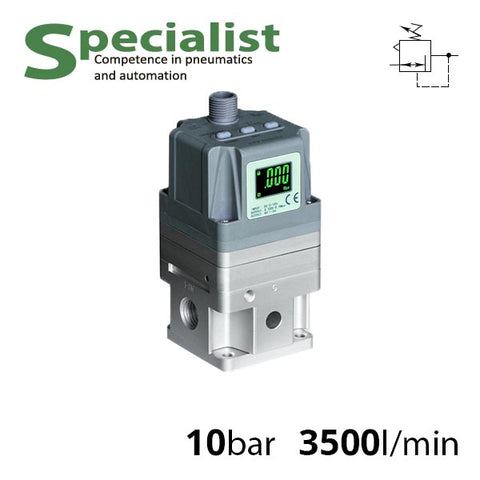
Electronic regulators are devices used for automated process control in various industries. They are designed to provide precise and stable pressure control. Analog control signals such as 4–20 mA, 0–5 V, and 0–10 V can be used.
The operating principle of electronic regulators is based on feedback. This means the device receives information about the current pressure and compares it with the set value. If there is a difference between the setpoint and the actual value, the regulator generates a control signal that adjusts system operation to achieve the desired pressure.
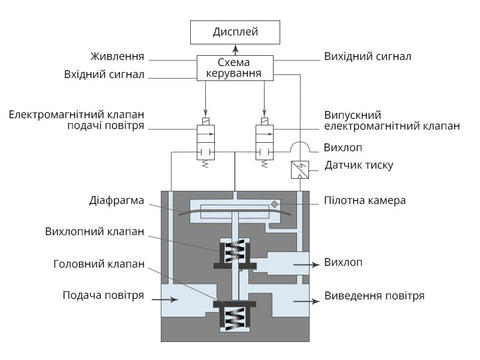
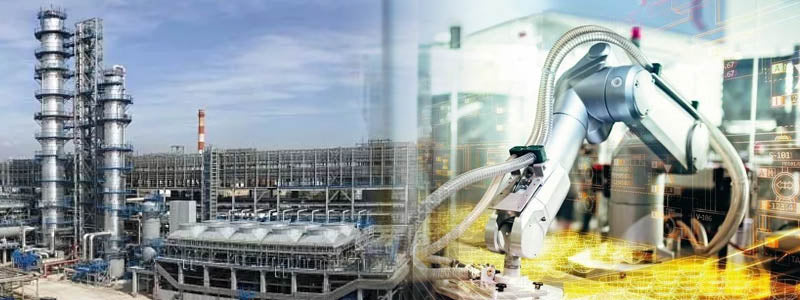
Electronic regulators are used in printing equipment to adjust roll braking force, in liquid filling equipment to maintain constant pressure in filling systems, in robotics, and in other industries requiring frequent outlet pressure changes and precise pressure regulation according to a programmed sequence.
Advantages and disadvantages of using such regulators
Electronic Pressure Regulators (EPR) offer several advantages over mechanical counterparts:
Disadvantages of electronic pressure regulators:
- Cost: an electronic air pressure regulator is generally more expensive than mechanical regulators due to the additional components required for its operation.
- Complexity: operation of the regulator requires the use of an industrial controller with an analog output, which can be purchased on our website. You can also order custom software development for controlling technological processes of any complexity.

Selecting the Optimal Pressure Regulator for Different Applications
Pressure Regulator Selection Criteria
When selecting a pressure regulator, the following criteria should be considered:
- Control range: it is necessary to choose an air pressure regulator that can provide the required pressure range for a specific application.
- Accuracy: different applications require different pressure control accuracy. For example, industrial applications may require accuracy in the range of 1–2%, while household applications may only require 5–10%.
- Maximum and minimum inlet pressure: select a pressure regulator capable of operating within the required pressure range.
- Body material: ensure that the regulator body material is suitable for the intended application and operating environment.
- Flow capacity: choose a pressure regulator capable of providing the required airflow rate.
Technical support: choose a manufacturer that can provide proper technical support, consultation, and after-sales service.
Installation and Adjustment Requirements
Installation, Adjustment, and Maintenance of Pressure Regulators
- Select a location for installing the pressure regulator. It should be easily accessible for maintenance and provide sufficient space for installation.
- Turn off the power supply and reduce the system pressure to zero.
- Install the pressure regulator in any convenient position. It can be installed at any angle or inclination without affecting its operation. It is typically mounted to a wall or another suitable surface using the mounting hardware supplied with the unit.
- Install the required fittings and pipelines, and connect the pressure gauge.
- After installation is complete, check the system for air leaks and set the required pressure.
Regular Maintenance and Component Replacement
Maintenance requirements may vary depending on the specific type and model of regulator. The following basic procedures should be considered:
- Check the regulator for leaks.
- Verify the regulator settings.
- Inspect the condition of the spring and diaphragm.
- Replace the regulator lubricant when necessary. This is only required if there is no air preparation system and the regulator is exposed to excessive moisture and used compressor oil.
Frequently Asked Questions
What is the difference between a reducer and a regulator?
When referring to an air pressure control device, there is no difference—they are simply two names for the same piece of equipment. It may also be referred to as an air reducer, pneumatic reducer, or compressor pressure regulator.
What is an air pressure reducer used for?
It allows compressed air pressure to be reduced to the required level and maintained at a constant value throughout operation. This is necessary because the pressure in the receiver after the compressor is constantly changing. However, it should be remembered that a reducer can only decrease pressure. For example, if the receiver contains 6 bar, you can obtain 4 bar using a reducer, but you cannot increase the pressure to 8 bar.
How do you adjust a pressure regulator?
- Determine the required outlet pressure.
- Carefully pull the regulator knob upward until it clicks.
- Turn the regulator knob clockwise or counterclockwise. The direction for increasing or decreasing pressure is indicated on the knob. The regulator gauge will display the pressure change.
- For greater adjustment accuracy, it is recommended to set the pressure while air is flowing through the regulator.
- If adjustment under airflow conditions is not possible, observe how much the outlet pressure drops once airflow begins. This will be visible on the pressure gauge. After airflow stops, increase the outlet pressure by the observed difference.
- Press the regulator knob down until it clicks to lock the adjusted pressure setting.
What is a compressor reducer?
This is the name given to a pressure regulator installed after a compressor to maintain a constant outlet pressure. It may also be referred to as a compressor pressure regulator.
What is a spray gun pressure regulator?
This is an air pressure regulator, often compact in size with G1/4 or G1/8 threaded connections, mounted directly on a spray gun and used to maintain constant compressed air pressure to ensure high-quality painting results. Based on our experience, the highest pressure control accuracy—and therefore the best painting quality—is achieved using precision regulators. However, they are best installed near the painting area on a wall or other equipment rather than directly on the spray gun.

