





Ball valves are among the most popular types of pipeline fittings used in modern water supply and heating systems. The designation "1/2" often raises questions among beginner installers and homeowners. What exactly does this fraction mean, and what diameter corresponds to a valve marked 1/2?
What Does the 1/2 Marking Mean?
The designation "1/2" (or 1/2") refers to the nominal bore (DN) of the valve and corresponds to the inch-based measurement system. This is a historical designation originating from the Anglo-American system of measurement, where 1 inch equals 25.4 mm. Therefore, 1/2 inch is approximately 12.7 mm.
However, it is important to understand that 1/2" is a nominal designation rather than the exact size of the internal passage or the external pipe diameter. Actual dimensions may vary depending on the standard and intended application of the product.

Main Dimensions of a 1/2" Valve
In plumbing practice, a valve marked 1/2" typically has the following characteristics:
- Nominal bore (DN): 15 mm
- Connection thread in inches: G 1/2" (male or female)
- Outside thread diameter: approximately 21 mm
- Internal passage diameter: approximately 13–15 mm
Thread Standards
Standardization of threaded connections is essential for the compatibility of plumbing products. For 1/2" valves, a cylindrical pipe thread according to DSTU ISO 228-1:2005 is used, corresponding to the international ISO 228 standard. This thread is designated as G 1/2".
In Ukraine, alongside international standards, DSTU dimensions are also used, where a 1/2" valve corresponds to DN15 (nominal diameter 15 mm).
British Inch Thread Conversion Table in mm

Applications of 1/2" Valves
Valves marked 1/2" are widely used in residential systems:
- Connecting plumbing fixtures
- Installation of heating systems
- Installation of household water filters
- Connecting washing machines and dishwashers
- Water distribution points in apartments and private houses

Pipe Compatibility
During installation, it is important to consider that a 1/2" valve can be connected to different types of pipes:
- 1/2" metal pipes
- Polypropylene (PVC) pipes Ø20 mm (using special fittings)
- Multilayer composite pipes Ø16 mm (using compression fittings)
- Copper pipes of the corresponding diameter
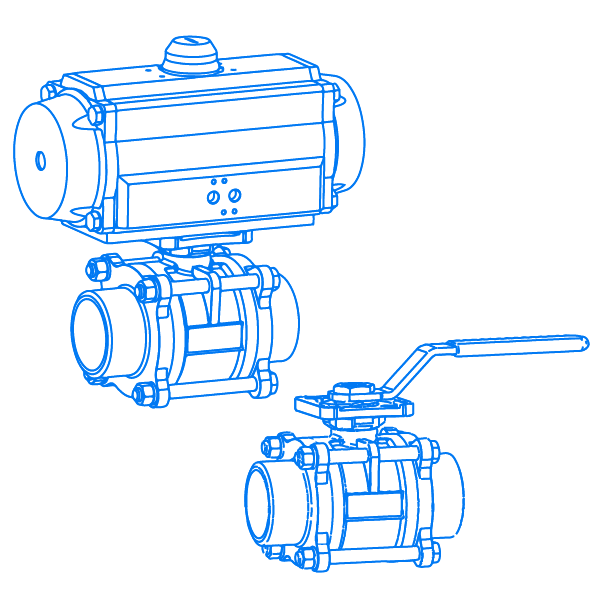
Choosing a Ball Valve
When selecting a 1/2" ball valve, pay attention to:
- Body material (brass, stainless steel, nickel-plated brass)
- Handle type (lever, butterfly)
- Operating pressure (typically up to 10–16 bar for residential systems)
- Operating temperature range
- Availability of quality certificates

Conclusion
Understanding the standards and dimensions of pipeline fittings is an important requirement for the proper installation of engineering systems and valves. The "1/2"" designation indicates a nominal valve bore of approximately 15 mm and the corresponding pipe thread size. As shown in the conversion table, for the 1/2" size, the outside thread diameter is 20.955 mm, while the inside diameter is 18.631 mm. These standardized dimensions ensure high compatibility between components from different manufacturers, making the installation and maintenance of water supply and heating systems accessible even to beginner installers.

