
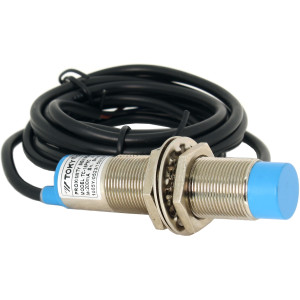
Inductive Sensors
Inductive Sensors
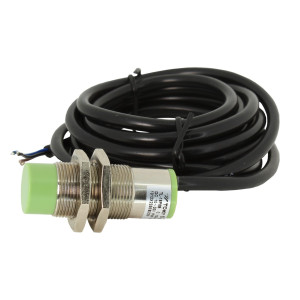
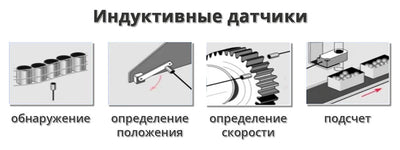
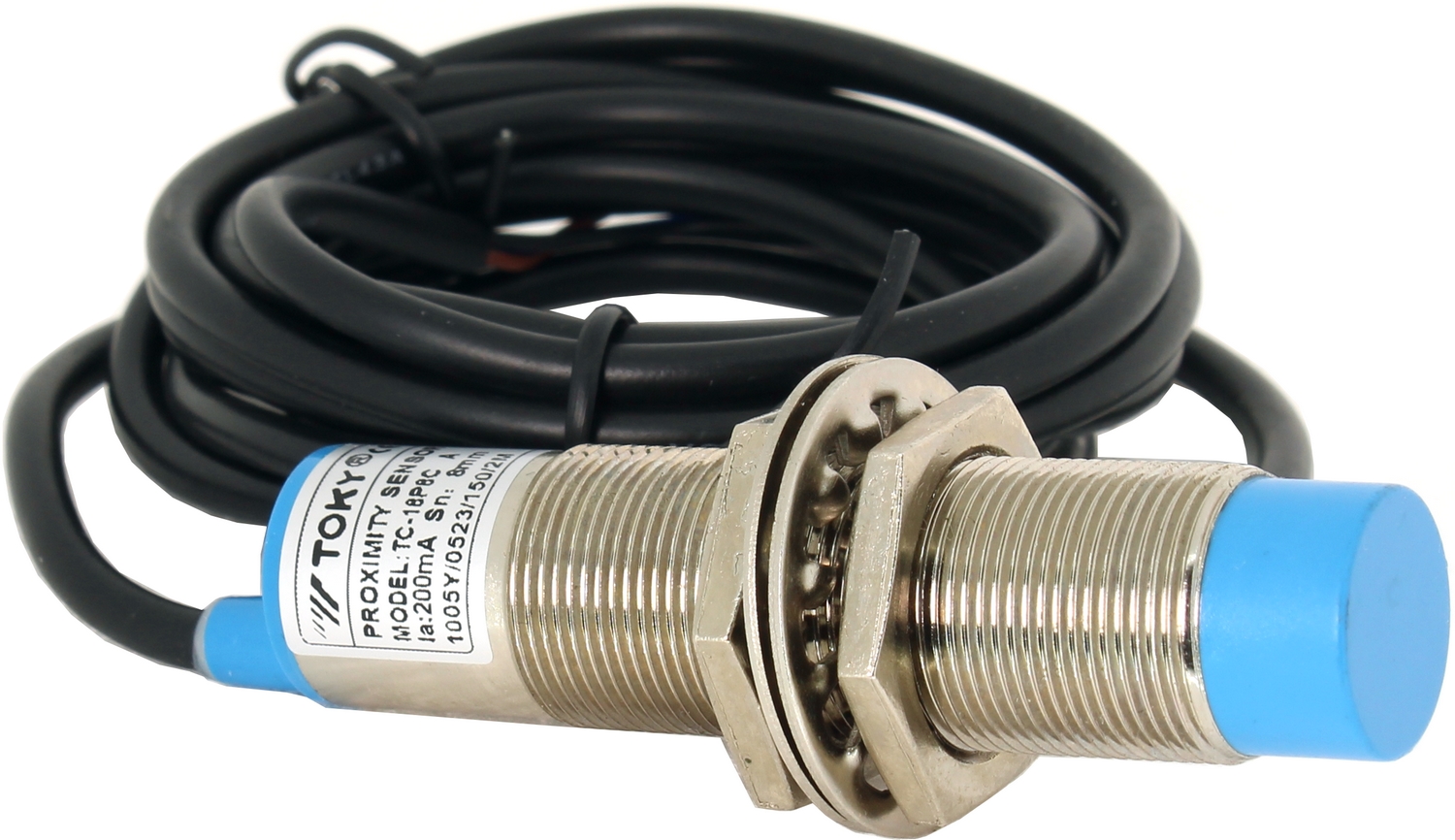
Inductive proximity sensor is a non-contact inductive switch (LBS) that switches an electrical signal upon detecting metal within its sensitivity zone (distance up to 15 mm). In industry, this type of detector is utilised in CNC machines, 3D printers, and for automating production and packaging conveyor lines where it is necessary to determine the position of various moving metal objects without direct contact, indirectly determine speed and account with PLCs.

Why buy an inductive sensor from “Specialist”?
We sell high-quality LBS sensors for production. The advantages of non-contact switches for metal object detection from “Specialist”:
-
Diode protection against incorrectly connected polarity
If incorrectly connected, cheap inductive sensors fail immediately due to overvoltage and overheating, whereas ours have protection. -
High-quality PVC cable 2 m included
The two-metre, reliably insulated, and soft 2 and 3-wire signal cable made from tinned copper in PVC with additional external insulation; -
Stability in industrial conditions
High vibration resistance and moisture protection of internal components with an IP66 class casing; -
Precision and interference resistance
SMT printed circuit board providing sensor accuracy, fast response, and minimising electromagnetic interference — depending on the model, sensors have an optimal frequency from 100 to 600 Hz; -
Ease of use
Our catalogue offers a wide selection of cylindrical inductive sensors in sizes M8~M30 with various cord and LED options, a square casing, flat, miniature. Noticeable light indication.
These advantages provide long-term operation and reliability for solving critical tasks in creating an automated system. We have analogues of inductive sensors lj12a3-4-z/by, and lj18a3-8-z/by, which are often used in CNC machines from China. Our limit switches have better construction and an IP66 sealed casing, making them almost fail-proof.
Features and benefits of different series:
- TL — basic and budget option with a threaded cylinder casing having two standard hex nuts.
- TK withstands twice the load current, the cylinder with threading has two additional locking washers for better fixation between the nuts.
- TKX offers a more noticeable 360° light indication, a wire bend protector, and a special hex nut for panel mounting.
- TKI and TKL — designed for convenient installation. This inductive limit switch has a round detachable pin-3 or pin-4 wire connector, straight or angled connection for the 2 m cord (included).
Connecting an inductive sensor
The 24V DC inductive sensor “Specialist” connects to a power supply from 10 to 30 V and has several configurations based on the type of output signal. It should be noted that all limit switches have a discrete ON/OFF output. A three-wire connection is usually used with a PNP or NPN transistor type signal, normally open or closed. The choice depends on both the method of action and the PLC, microcontroller, inverter, or other device that will receive the signal.
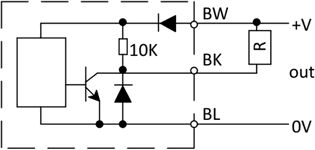
Connection diagram of an NPN inductive sensor

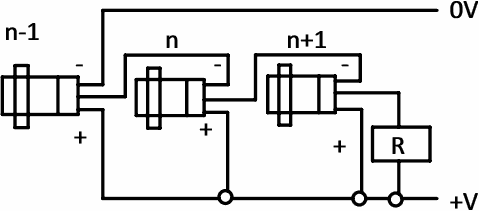
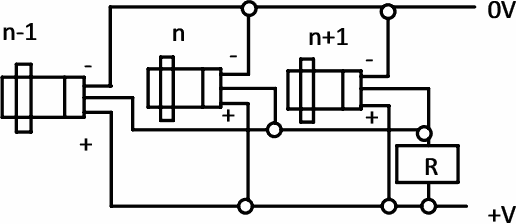
Several NPN sensors can be connected in series:

NPN limit switches can also be connected in parallel:

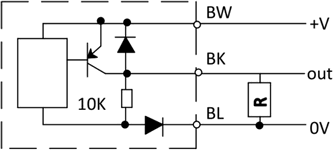
Connection diagram of a PNP inductive sensor

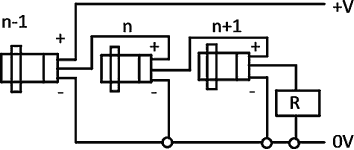
Serial connection of a series of LBS PNP sensors:

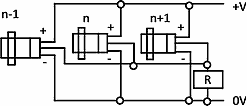
Parallel connection of PNP terminators:

How and to which metals do inductive sensors (LBS) react
The magnetic-inductive metal sensor is versatile and detects various metallic objects in its vicinity, but its sensitivity differs between ferrous and non-ferrous alloys. The sensor best detects iron plates. The proximity distance for other metals is adjusted by the distance correction factor Sn.
| Metal | Proximity (factor) |
|---|---|
| Steel | 1 Sn |
| Stainless steel AISI | 0.83 Sn |
| Brass | 0.59 Sn |
| Aluminium | 0.51 Sn |
| Copper | 0.43 Sn |
Sometimes the magnetic-inductive sensor is confused with the electromagnetic reed switch, which is also available in our online store. These devices operate on different principles and have different applications. Call our engineer managers, who will help select a device tailored to your requirements.
Main operational characteristics of the inductive sensor:
- Maximum sensitivity in millimetres. We have sensor detectors available with response distances from 2 to 15 mm, and can offer by special request models up to 25 mm.
- Electrical parameters of the output signal – voltage, current, and current type (AC or DC).
By mounting method, less expensive inductive sensors are made with a plastic rectangular IP66 case, fixed with two screws. However, more popular sensors are in cylindrical enclosures, made from nickel-plated bronze, stainless steel, or other metals, with metric threaded holes. This allows them to be easily integrated into machine panels and conveyor belts.
The most popular model is SE-SEN-TK-12P4C — an inductive PNP-type sensor with an approach distance up to 4 mm and M12 casing. It is widely used in 3D printers and CNC machines. You can find the required sensor by parameters in our store or call an engineer-consultant to help make the optimal choice according to your requirements.
Request a variant
Fill in the form and we will get back to you regarding this variant.